Wine, Perception, and Power
What a Glass of Wine Reveals About How We Experience the World

I recognize that when wine enthusiasts mention wet gravel, leather, or graphite, many non-enthusiasts roll their eyes and secretly wish that person would spontaneously combust. I get it, but I am not one of those people. For me, drinking wine with an oenophile is a rarified pleasure. This is partly because my own family has zero interest in it, so I can’t really indulge in this at home, but mostly because of the focused attention on experience that it entails: during the tasting process, all of one’s senses are focused on the wine and only the wine.
But focus is not enough; to understand, appreciate, and discuss these sensations and experiences we need the right language.
Three of us were having dinner at my friend Peter’s house, a “safe space” for nerding out on the minutia of flavors and terroir (as well as on all things China). Peter is a sommelier-in-training, our mutual friend an accomplished one, and I merely an interested amateur. As we were tasting a wine from Bordeaux, I was able to distinguish and give voice to several of the distinct flavors, but there was one that I just couldn’t put my finger on. Rather than tell me, Peter took out his copy of Wine Folly and displayed the flavor wheel. As soon as I saw the word I knew what it was: mint! Mint in a red wine? Black cherry, red plum, chocolate…sure…but mint had not even remotely been on my radar.
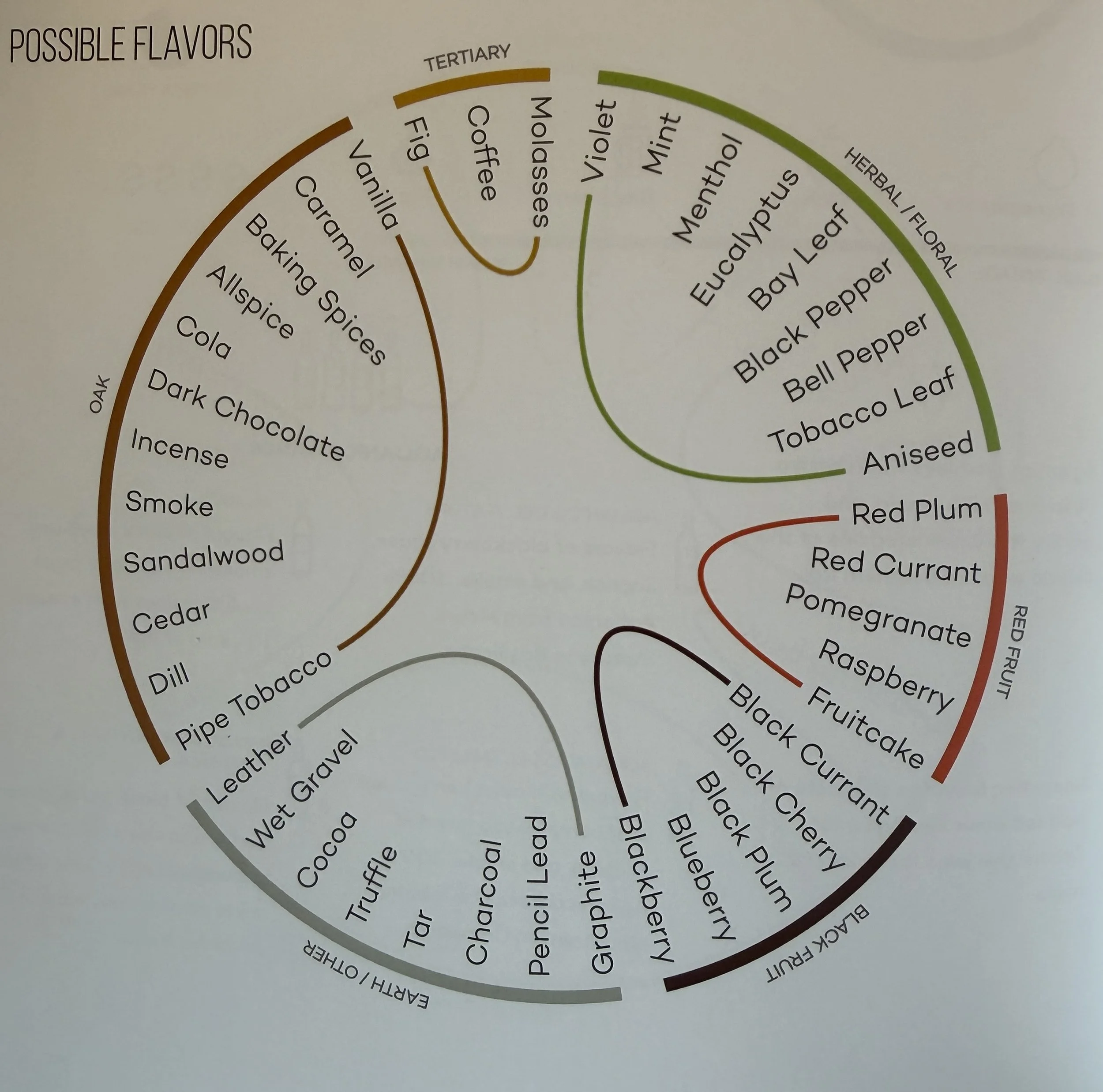
Image credit: Puckette and Hammack, Wine Folly: The Essential Guide to Wine. (1)
Language plays a critical role in how we experience and describe wine. For some people, maybe “this tastes great and I like it” is sufficient. But to someone curious about exactly what makes this a wine that they like, a more expansive vocabulary is required.
To novices, the sensation of drinking wine is often experienced as a kind of perceptual whole: we may know that we like the wine–perhaps that it tastes “big and fruity”–but have difficulty identifying exactly why. It is difficult to get beyond that level of analysis if one hasn’t been exposed to wine tasting terminology. Learning the nuanced language of wine gives us a way to divide that experience into component parts and sensations. More importantly, this vocabulary doesn’t just help us describe what we have already tasted–it can teach us what to notice.
To be clear, I am not claiming that we can’t taste the wine before we have the words for it. I tasted mint before seeing the word “mint.” Language didn't put mint into the Bordeaux. What changed was my ability to apprehend mint. Language gives us conceptual categories that help us attend to and distinguish sensations that previously registered more or less as an undifferentiated whole.
This is fairly intuitive. But the aspect I want to emphasize is that language is not merely descriptive of perception; it can help structure our attention and then, through that attention, refine perception. To make a somewhat tortured metaphor, language supplies the tongs with which attention can grasp the experience. Without conceptual distinctions, aspects of experience may remain perceptually present but cognitively invisible.
There is ample theory to back this up. Linguists and philosophers have argued for generations about how language shapes thought. The Sapir-Whorff hypothesis is perhaps the most well known. Sapir-Whorff comes in two main flavors: strong and weak, with the strong claiming full linguistic determinism (now mostly refuted) and the weak merely claiming that language influences thought and shapes certain aspects of cognition. (2)
I don’t want to get into a full academic discussion of these here. For our purposes, we only need to accept the more modest proposition that language and vocabulary directs our attention and makes certain distinctions easier to perceive. Some of these are sensations we already have, like the mint in the wine, and others might be ones that we would otherwise struggle to consciously perceive. As such, the terms we use and have access to directly impact our phenomenological experience, both limiting and offering windows to it.
If we are just dealing with wine tasting, the stakes aren’t too high. You want to call it big and fruity and I want to talk about the distinct notes and flavors? Fine. Worst case, you don’t want to hang out and drink wine with me anymore. The problem is that the same mechanism is at work whenever we have sensation without discrimination. The sensation is there but we don't have the words needed for scrutiny and awareness. To go back to the tongs metaphor, not only do the tongs allow you to grasp, but also to dissect.
Wine is harmless because failing to distinguish graphite and mint doesn't really matter. But what if we apply this to another area of our lives, like our relationship with technology? What happens when the experience we fail to distinguish is anxiety, compulsion, loneliness, distraction, humiliation, dependence, or diminished agency?
Let’s take doom scrolling as an example. We know intuitively that it has detrimental effects on us, but do we have the words to describe them? After 45 minutes of scrolling we may feel “head fog,” or recognize that time passed more quickly than we thought, or that we are struggling to stop scrolling. We sense that it is bad for us, but don’t really know why. So we just call it “doom scrolling” and move on. But to me this feels like the “big and fruity" of psychological experience. It’s not wrong, but it also doesn’t fully access the layers of experience needed for deeper comprehension. To continue the wine comparison, what would the flavor wheel for doom scrolling look like?
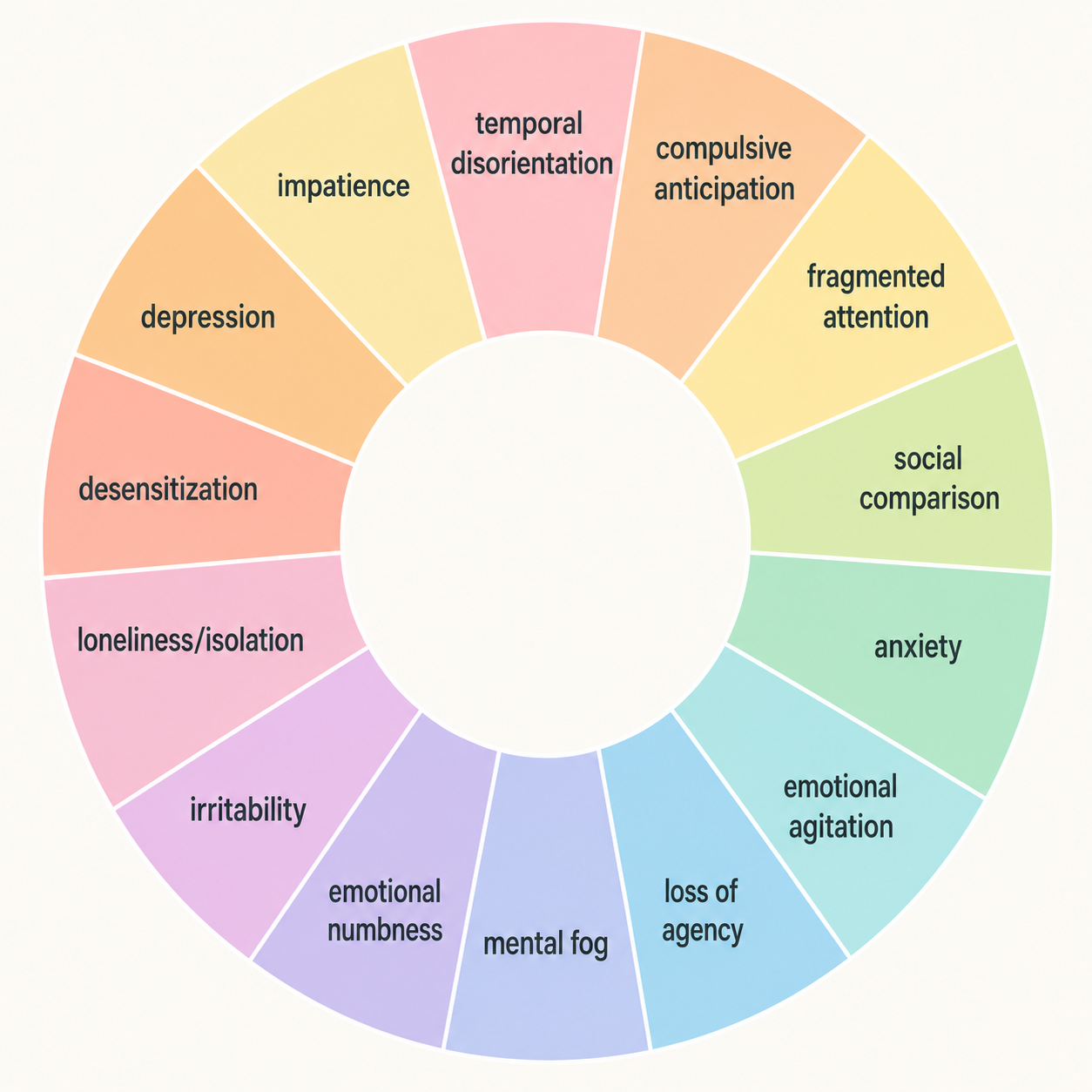
A quick and unthorough attempt to show what the concept might look like.
The 18th-century Scottish philosopher David Hume believed that the lack of refined definitions of things holds us back from true understanding: “"The chief obstacle, therefore, to our improvement in the moral or metaphysical sciences is the obscurity of the ideas, and ambiguity of the terms."(3)
Hume continues:
By what invention can we throw light upon these ideas, and render them altogether precise and determinate to our intellectual view? Produce the impressions or original sentiments, from which the ideas are copied. These impressions are all strong and sensible. They admit not of ambiguity. They are not only placed in a full light themselves, but may throw light on their correspondent ideas, which lie in obscurity. And by this means, we may, perhaps, attain a new microscope or species of optics, by which, in the moral sciences, the most minute, and most simple ideas may be so enlarged as to fall readily under our apprehension, and be equally known with the grossest and most sensible ideas, that can be the object of our enquiry. (4)
Hume was pursuing a mathematical certitude in metaphysical and moral examination, but language and terms matter beyond just specificity of terms and concepts. Acquiring the right vocabulary isn’t just about talking to others about it. It is what would allow us to notice, in our example, the aspects of doom scrolling that we want to curb. If language allows us to distinguish aspects of our experience, those distinctions are also what allow us to evaluate that experience. Was I entertained? Manipulated? Both? Did this technology serve me, or was I, in some subtle, subconscious way, serving the technology?
The point is this: if we can’t name what is happening to us, then we can’t consent to it, resist it…or even fully claim that we experience it. It is like sleepwalking through life.
There is a darker, more insidious side to this as well. With language comes power (and vice versa). If we aren’t supplying the required language ourselves, then we are unarmed when someone else decides which words to use, determining for us what aspects of the experience we notice and which we overlook. Lack of awareness can make us victims.
Mark Zuckerberg recently published one of the most tone-deaf and self-unaware essays yet on the future of AI and humanity, titled The Future is For Everyone.(5) Zuckerberg frames AI values around the words liberty, open inquiry, free enterprise, and equal opportunity. Zuckerberg’s linguistic framing directs our attention to a set of concepts that do not remotely help us understand the human experience. The main character in his world is the AI company, not the AI user. Ultimately this is an essay about deregulation, disguised as one about values. If we want to ask Zuckerberg to give us tasting notes for this glass of AI, he is not responding with the flavors we experience when drinking it, but rather details about its manufacture, like “made from hand-picked grapes, fermented with yeast and fed on sugar, and presented in bottles made from silica sand, soda ash, and limestone.” It tells us nothing of our experience of imbibing it.
This matters because if AI is discussed primarily through the values framework of liberty, opportunity, innovation, choice, and capitalism, then certain questions are brought to the conscious foreground, while others recede or disappear. We don’t focus our attention on agency, autonomy, alienation, dependence, manipulation, attention, or human connections…we don’t talk about dignity.
Rather, Zuckerberg offers up the philosophically frail response that people should just decide for themselves what is good and bad about AI: “The history of democracy and economics has shown that there is no single objective answer to how people define the best life, and therefore the best approach is letting people decide what matters in their own lives.” But what if we don’t know what matters because we can’t describe it and don’t perceive it?
This is the crux of my project: expanding our understanding of dignity by developing a more nuanced and specific set of language around what human dignity actually is. The hope is that with that expanded vocabulary we will better be able to focus on what detracts and enhances it, applying this to our relationship with technology. Because it’s hard to govern something that we can’t describe.
Ultimately, the answer isn't to focus on the tool, but on the human who is using it. Before asking how we should govern AI, social media, or whatever comes next, we need a richer vocabulary for describing what these technologies actually do to human beings. We need, in effect, a flavor wheel for dignity and the human experience.
Notes
(1) If you are interested in wine tasting, this is the book to get: Puckette, Madeline, and Justin Hammack. Wine Folly: The Essential Guide to Wine. New York: Avery, 2015.
(2) I know it is much more complicated than this. Have mercy, dear academic readers.
(3) Hume, An Enquiry Concerning Human Understanding, VII.1.48 https://www.gutenberg.org/files/9662/9662-h/9662-h.htm
(4) Ibid., VII.1.49.
(5) https://www.meta.com/thefutureisforeveryone/
